How Often Should You Get Dental X-Rays in North Hollywood?
Few topics generate more patient questions — and occasional skepticism — than dental X-rays. How often do you actually need them? Are they safe? Is your dentist recommending dental X-rays in North Hollywood too frequently?
These are fair questions and they deserve straight answers. At A-Dental Center, we follow evidence-based guidelines and are always happy to explain exactly why we recommend what we recommend.
What Do Dental X-Rays in North Hollywood Actually Show?
What X-Rays Reveal That a Visual Exam Cannot
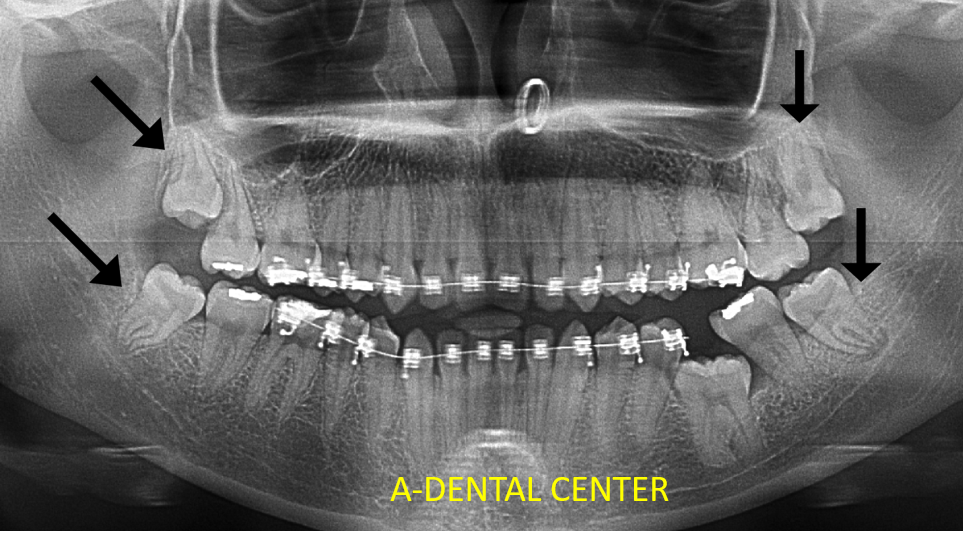
Dental X-rays in North Hollywood reveal what clinical examination simply cannot. They show several critical things that would otherwise go completely undetected:
- Cavities forming between teeth or under existing restorations — completely invisible to the naked eye until they have grown large enough to require complex treatment. Our post on what happens if you don’t fill a cavity explains exactly how fast untreated decay progresses once it goes undetected.
- Bone loss from gum disease — occurring below the visible gum line. This is directly connected to gum recession that patients often do not notice until significant damage has already occurred.
- Impacted, unerupted, or problematic wisdom teeth — often completely asymptomatic until they cause damage to adjacent teeth
- Infections or cysts at the root tips of teeth — detectable only through imaging
- Root fractures and other structural issues — frequently missed without X-ray confirmation
Why X-Rays Are a Diagnostic Necessity
X-rays are not a profit generator. They are a diagnostic necessity. A dentist who does not take X-rays is providing clinically incomplete care — and patients who decline X-rays consistently face more complex and expensive treatment when problems are eventually discovered.
How Often Does the ADA Recommend Dental X-Rays in North Hollywood?
Why Frequency Is Individualized
The American Dental Association does not prescribe a single X-ray schedule for all patients. Instead, it recommends that frequency be individualized based on each patient’s risk assessment. General guidelines are as follows:
Low-Risk Adults
Patients with no recent cavities, healthy gums, and good home care typically need bitewing X-rays every 18–24 months. Full-mouth X-rays are generally needed every 3–5 years.
Moderate to High-Risk Adults
Patients with a history of cavities, gum disease, dry mouth, or diabetes typically need bitewing X-rays every 6–12 months. More frequent monitoring helps catch problems before they escalate.
New Patients
Full-mouth X-rays or a panoramic X-ray are typically taken at the first visit regardless of risk level — to establish a baseline and identify anything requiring attention. This is one reason your first appointment after years away will include a full X-ray series.
Children
More frequent X-rays are often warranted for children because decay progresses faster in primary and newly erupted permanent teeth.
Is the Radiation From Dental X-Rays in North Hollywood Dangerous?
The Numbers Put It in Perspective
Modern digital dental X-rays deliver an extraordinarily small amount of radiation — far less than conventional film X-rays and a fraction of what you are exposed to from background radiation in daily life.
A full set of dental bitewing X-rays delivers approximately 0.005 millisieverts of radiation. A cross-country flight, by contrast, exposes you to roughly 0.04 millisieverts. Living at sea level for a full year delivers approximately 2.4 millisieverts from background sources alone.
What Research Confirms
The American Dental Association confirms that the radiation dose from dental X-rays is among the lowest of any medical imaging procedure available. As a result, concerns about radiation exposure from dental X-rays are not supported by the clinical evidence.
Special Consideration for Pregnant Patients
For patients who are pregnant, X-rays are generally deferred unless there is an urgent clinical need. In those cases, proper shielding is always used to minimize any exposure.
Can You Decline Dental X-Rays in North Hollywood?
You Always Have the Right to Decline
You always have the right to decline any dental procedure — including dental X-rays in North Hollywood. However, understand that doing so limits your dentist’s ability to make an accurate diagnosis. Problems caught on X-ray at an early stage cost a fraction of what they cost when discovered later through symptoms.
What Declining Actually Means for Your Treatment
If a cavity develops between your teeth and your dentist has not had X-rays to catch it early, the conversation about why treatment is now more complex is an awkward one. Our post on what happens if you don’t fill a cavity illustrates exactly what that progression looks like — from a simple $200 filling to a potential root canal and crown.
The Right Approach
If you have concerns about X-ray frequency, have an honest conversation with your dentist about your individual risk factors. At A-Dental Center, we are always happy to explain our recommendations clearly and transparently.
Additionally, the Mayo Clinic notes that transparent communication between patient and dentist — including about diagnostic recommendations — is one of the most important foundations of a successful long-term dental relationship.
Dental X-Rays and Your Cleaning Visit in North Hollywood
If you are also due for a cleaning and wondering what that involves, read our breakdown of what a teeth cleaning costs without insurance in North Hollywood — X-rays are often bundled with your first visit and the post explains exactly what is included. For a comprehensive overview of everything that happens at a checkup, read our post on what a dental checkup actually includes.
Questions about your X-ray schedule? Call (818) 593-0700 and we will walk you through exactly what we recommend and why.