
Root Canal in North Hollywood & Los Angeles: Same-Day Tooth Pain Relief
Suffering from severe tooth pain? Dr. Elzayat can often provide same-day relief. We answer 24/7, so call (818) 593-0700 right now.
- ★ 700+ Five-Star Google & Yelp Reviews
- ✓ USC-Trained & FICOI-Credentialed Dentist
- ✓ Bilingual Team, Se Habla Español
- ✓ Most PPO Insurance Accepted
- ✓ Same-Day & Emergency Appointments
- ⭐⭐⭐⭐⭐ "I was terrified and in so much pain. They got me in same day and I left completely comfortable." M.R., North Hollywood
- ⭐⭐⭐⭐⭐ "Painless shots and the Dr explains each step which helps me feel calmer. Great work!." G.S, Valley Village
★★★★★
4.9
Google Rating
★★★★★
700+
Five-Star Reviews on Google & Yelp
20+
Years in NoHo
USC
School of Dentistry
FICOI Fellow
International Congress of Oral Implantologists
Same Day
Appointments: Book Here
Know the Warning Signs
Do You Need a Root Canal? Signs and Symptoms
Your tooth is telling you something is wrong. These are the most common signs that the pulp inside your tooth is infected or dying. Do not ignore them.
If you have any of these symptoms, call A-Dental Center at (818) 593-0700 immediately. Same-day appointments are available. Do not wait. Dental infections can spread rapidly and become a serious medical emergency.
Call Now: (818) 593-0700Root Canal Symptoms by Tooth Location
Not all root canals feel the same. Where the infected tooth sits in your mouth affects both the symptoms you experience and the complexity of the procedure. Here is what to expect depending on which tooth is affected:
| Tooth Location | Common Symptoms and Notes |
|---|---|
| Front Teeth (Incisors) | Visible darkening or grey discoloration; sensitivity to temperature changes. Single root canal means a shorter, more straightforward procedure. |
| Canines | Persistent dull ache, sometimes radiating into the upper lip or nose. Single root makes treatment straightforward with a predictable outcome. |
| Premolars (Bicuspids) | Pressure pain when biting down; sensitivity to sweets. Premolars have 1 to 2 canals, making treatment moderately straightforward. |
| Molars | Most complex root canal. Pain often radiates to the jaw or ear and can be mistaken for an earache. Molars have 3 to 4 canals. CBCT 3D imaging is especially helpful here to map root anatomy accurately before treatment. |
| Wisdom Teeth | Root canal treatment on wisdom teeth is rarely recommended. The location makes access difficult and long-term success rates are lower. Extraction is usually the preferred treatment for an infected wisdom tooth. |
Setting the Record Straight
Are Root Canals Painful? The Truth.
This is the most common fear patients bring to our office. Here is the honest answer:
A root canal does not cause pain. It relieves it. The pain patients fear is the pain of the infection that was already there. The procedure itself removes that infection.
The root canal procedure is performed under local anesthesia. The tooth and surrounding tissue are completely numb before anything begins. You will feel pressure and movement, but not pain. Most patients are surprised by how routine it feels.
Modern rotary endodontic instruments have made root canal treatment significantly faster and more comfortable than it was even ten years ago. What once required multiple long appointments can often be completed in a single visit at A-Dental Center.
After the procedure, some mild soreness for two to three days is normal as the surrounding tissue heals. Over-the-counter pain relief is usually sufficient. Most patients return to work or normal activities the same day or the next morning.
"I was so scared for nothing. It was easier than getting a filling. Dr. Elzayat was calm and patient the whole time and I felt completely in control."
A-Dental Center patient, North Hollywood
for root canal experience
root canal cases
procedure itself
Do I Need a Root Canal or an Extraction?
This is one of the most important decisions a patient with an infected tooth has to make. The short answer: if the tooth can be saved, a root canal is almost always the better long-term choice. Here is why.
| Root Canal | Tooth Extraction | |
|---|---|---|
| The Tooth | Preserved: your natural tooth stays | Removed permanently |
| Function | Biting and chewing restored to normal | Requires implant or bridge to restore function |
| Total Cost | From $895 (front tooth) or $1,400 (premolar or molar), plus core buildup and crown | Extraction from $349 + implant from $2,799 |
| Bone Health | Jawbone preserved around the root | Bone loss begins immediately after extraction |
| Timeline | 1 to 2 appointments; crown placed within days | 1 appointment for extraction + months of healing before implant |
| Best When | Tooth structure is restorable | Tooth is cracked below the gum line or beyond saving |
What Happens If You Ignore a Root Canal?
A dental infection does not go away on its own. Without treatment, it follows a predictable and serious progression. Here is what happens when a root canal is delayed:
| Timeline | What Happens Without Treatment |
|---|---|
| Week 1 to 2 | Infection spreads through the root canals. An abscess may form at the tip of the root, causing increasing pressure and pain. |
| Month 1 | The abscess grows. Surrounding bone begins to dissolve. The tooth may start to feel loose. Pain often intensifies at this stage. |
| Month 2 to 3 | Infection can spread to the jaw, neck, and sinuses. At this stage it becomes a serious medical emergency requiring hospitalization in some cases. |
| Month 3+ | The tooth becomes non-restorable. Extraction is now the only option. An implant or bridge is then required to restore function, at significantly higher cost. |
| Long Term | Bone loss, shifting of neighboring teeth, bite problems, and a treatment cost that can be three to five times higher than the original root canal would have been. |
A dental infection is not something that resolves on its own. Antibiotics may reduce symptoms temporarily, but they do not eliminate the infection. The bacteria remain inside the tooth. The only definitive treatment is a root canal or extraction.
If you are in pain right now, do not wait. Call us today.
Call (818) 593-0700 NowWhat to Expect
The Root Canal Procedure: Step by Step
Knowing exactly what happens during a root canal takes the fear out of the unknown. Here is the full process at A-Dental Center, from diagnosis to restoration.
Digital X-rays or a CBCT 3D scan confirms the infection and maps the root anatomy before any treatment begins. Accurate imaging is critical for complex molar cases with multiple canals.
The tooth and surrounding gum tissue are fully numbed. You will feel pressure and movement during the procedure, but not pain. We do not proceed until you confirm the area is completely comfortable.
A thin rubber dam is placed around the tooth to isolate it from the rest of the mouth. This creates a sterile, controlled environment and prevents bacteria from re-entering the tooth during treatment.
A small opening is made in the crown of the tooth to access the infected pulp chamber. For front teeth this access point is on the back surface. For molars it is on the biting surface.
Infected pulp tissue is removed using precision rotary endodontic files. The canals are carefully shaped to accept the filling material. Rotary instruments make this step faster and more comfortable than older manual techniques.
The canals are thoroughly flushed with an antibacterial solution to eliminate any remaining bacteria and debris. This step is essential for preventing re-infection.
The cleaned canals are sealed with gutta-percha, a biocompatible rubber material. This permanently fills the space where the pulp was, preventing bacteria from re-entering the root system.
A temporary or permanent dental crown is placed to restore the tooth's full strength and function. Most root-canal-treated teeth require a crown to prevent cracking. We aim to place the permanent crown within the same week whenever possible.
Root Canal Recovery and Aftercare
Most patients are relieved by how quick and manageable recovery actually is. Here is what to expect in the days following your procedure.
Day of Procedure
The area will feel numb for several hours after treatment. Avoid eating on that side until sensation fully returns. Most patients go back to their normal routine the same afternoon.
Days 1 to 3
Mild soreness or tenderness around the treated tooth is normal as the surrounding tissue heals. Ibuprofen or acetaminophen is usually sufficient. This discomfort is far less than the original infection pain.
What to Eat
Stick to soft foods for the first 48 hours: yogurt, soup, eggs, mashed potatoes. Avoid hard, crunchy, or chewy foods while the temporary crown is in place.
After Your Crown
Once the permanent crown is placed, the tooth functions exactly like a natural tooth. Brush and floss normally. No special maintenance is required beyond your regular dental check-ups.
Transparent Pricing
How Much Does a Root Canal Cost in North Hollywood?
Root canal cost depends on which tooth is being treated and how many canals it has. Here are our starting fees at A-Dental Center. Each is a "from" price because the final fee depends on your tooth and case. Root canal pricing excludes the core buildup and crown.
| Tooth Type | Starting Fee |
|---|---|
| Anterior (front tooth): incisor (1 canal) | From $895 |
| Anterior (front tooth): canine (1 canal) | From $895 |
| Premolar / bicuspid (2 canals) | From $1,400 |
| Molar (3 to 4 canals) | From $1,400 |
| Core buildup and crown | Quoted separately |
Root Canal Financing and Insurance
Cost should not be the reason you delay treating a dental infection. We make root canal treatment accessible through insurance verification, flexible financing, and transparent pricing.
Most PPO dental plans cover 40 to 80% of root canal cost. We verify your benefits before treatment so you have no surprises.
Flexible monthly payment plans with a quick approval process. Soft credit check. Apply in minutes at the office or online.
Widely accepted healthcare credit card with promotional 6 to 24-month financing options for qualifying patients.
Flexible Financing
Flexible financing options are available through CareCredit and Cherry, subject to approval and plan eligibility.
The Benefits of Root Canal Treatment
Root canal treatment is one of the most effective and well-proven procedures in dentistry. Here is what it does for you:
The infection causing the pain is removed. Most patients feel dramatic relief within 24 hours of the procedure.
The best restoration is always your own tooth. A root canal allows you to keep it for many more years.
Eliminates the bacterial infection before it can spread to the jaw, sinuses, neck, or bloodstream.
With a crown placed after treatment, you can bite and chew on that tooth normally again.
Keeping the root in place prevents the bone loss that begins immediately after an extraction.
A root canal plus crown is significantly less expensive than extraction followed by a dental implant, which can cost three to five times more.
Patient Cases
Root Canal Case Studies at A-Dental Center
Every case is different. Here are three examples of patients Dr. Elzayat has treated at our North Hollywood office.
Presenting Symptom
Severe throbbing pain in upper left molar, worsening at night. Patient unable to sleep and avoiding eating on that side for two weeks.
Diagnosis
Pulp necrosis confirmed on CBCT imaging. Abscess present at the root tip with early bone loss around the apex.
Treatment
Single-visit root canal: molar, 3 canals cleaned and sealed. Porcelain crown placed the following week.
Outcome
Patient pain-free within 24 hours. Crown in place within one week. Tooth fully restored to normal function with no complications.
Presenting Symptom
Patient noticed upper front tooth darkening progressively over three months after a sports injury. No acute pain, but a small bump on the gum above the tooth.
Diagnosis
Pulp necrosis from previous trauma. Periapical abscess confirmed on X-ray. The tooth had no pain because the nerve had already died.
Treatment
Root canal on upper incisor: single canal, completed in one visit. Internal bleaching performed afterward to address discoloration. Tooth-colored composite seal placed.
Outcome
Infection resolved. Abscess healed over 6 weeks confirmed on follow-up X-ray. Tooth shade significantly improved. Natural tooth preserved with no extraction needed.
Presenting Symptom
Sharp pain on biting down on lower right side. Patient called at 8am; was seen the same morning. Sensitivity to cold lingering for over a minute.
Diagnosis
Cracked cusp extending into the pulp chamber of lower premolar. Early-stage pulpitis confirmed on digital X-ray. Tooth restorable.
Treatment
Same-day root canal on premolar: 2 canals. Cracked cusp removed and tooth built up with core material. Permanent crown placed one week later.
Outcome
Patient pain-free by that evening. Crown seated with no complications. Patient returned to full diet within two weeks. Tooth intact and functional.
Emergency Root Canal
Same-Day Emergency Root Canal at A-Dental Center
When you are in tooth pain, waiting days for an appointment is not acceptable. A-Dental Center offers same-day emergency root canal appointments whenever scheduling allows.
If you are experiencing severe pain, facial swelling, or a dental abscess, call us immediately. Our phone line is answered 24 hours a day, 7 days a week for appointment scheduling.
Do not wait for the pain to worsen. A spreading dental infection is a medical emergency. Early treatment means a simpler procedure, faster recovery, and a tooth that can still be saved.
for emergencies
available when
scheduling allows
Why Choose Us
Why Choose A-Dental Center for Root Canal Treatment?
Not all dental offices treat root canals the same way. Here is what makes A-Dental Center a different experience:
CBCT 3D Imaging
Our Cone Beam 3D scanner maps the exact anatomy of your root canals before treatment begins. This means fewer surprises, more accurate cleaning, and better outcomes, especially for complex molar cases.
Gentle Rotary Endodontic Technique
Dr. Elzayat uses precision rotary instruments rather than manual files. This makes the cleaning process faster, more thorough, and more comfortable than traditional techniques.
Same-Day Availability
We prioritize emergency root canal patients. Call us 24/7 at (818) 593-0700 and we will get you in as soon as possible, often the same day.
Se Habla Español
Our team serves the Spanish-speaking community in North Hollywood. Full consultations and treatment planning are available in Spanish.
Most PPO Insurance Accepted
We verify your dental benefits before treatment so you know your out-of-pocket cost in advance. No billing surprises. Cherry and CareCredit financing available for remaining balances.
ZocDoc Online Booking
Book your root canal consultation online anytime through ZocDoc, or call us directly at (818) 593-0700. Emergency appointments are prioritized by phone.
You do not have to live with tooth pain.
Call A-Dental Center right now. Same-day appointments available for patients in pain.
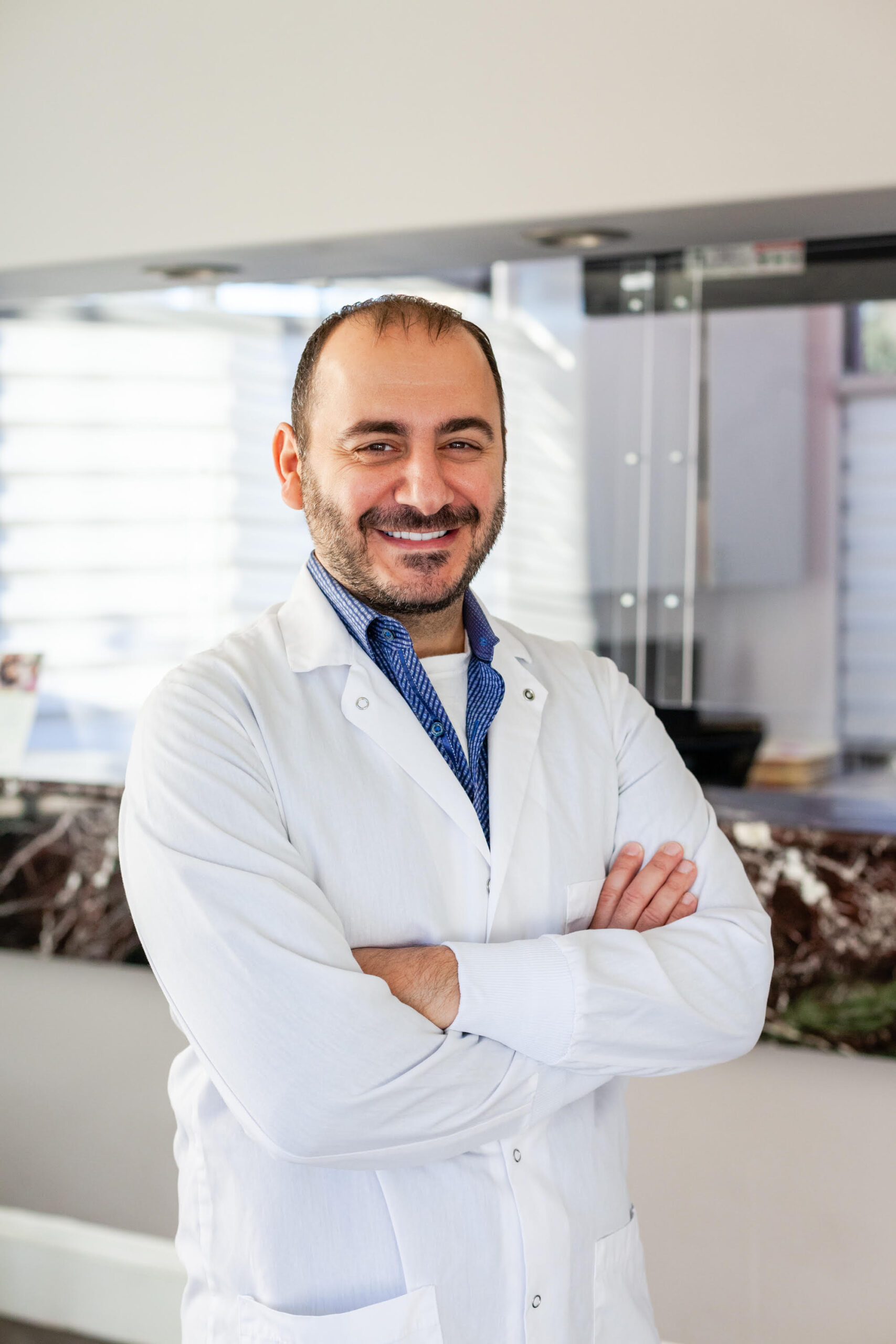
⭐⭐⭐⭐⭐ “The doctor was very insightful and took the time to explain the root cause of my dental issues in a way I could understand.”
V.C.
Meet Your Dentist
Meet Dr. Fadi Elzayat, DDS, FICOI
A-Dental Center has been a trusted part of the North Hollywood community since 1998. Dr. Fadi Elzayat has led the practice since 2008, bringing over 20 years of clinical experience in dental implants, All-on-4, full arch restorations, and comprehensive family dentistry.
A graduate of the USC Herman Ostrow School of Dentistry, one of the top dental schools in the country, Dr. Elzayat holds a Fellowship from the International Congress of Oral Implantologists (FICOI).
He focuses on cosmetic dentistry, with a strong emphasis on dental implants and advanced full-arch solutions. He performs every implant case personally and in-house, often utilizing Cone Beam 3D imaging for precision planning.
No referrals. No outside oral surgeons. Every phase of your treatment, from consultation to final restoration, is handled or supervised by Dr. Elzayat at A-Dental Center.
Beyond clinical skill, Dr. Elzayat is known throughout North Hollywood as “The Friendly Dentist” for his calm, straightforward approach, gentle technique, and zero-pressure consultations. A strong focus on comfort and clear communication ensures that each visit feels personalized and supportive.
Whether you haven’t seen a dentist in years or are facing a complex full arch case, patients from North Hollywood, Burbank, Studio City, and the greater San Fernando Valley are welcomed into a setting designed for a relaxed, judgment-free experience.
Credentials:
 USC School of Dentistry Graduate
 FICOI Fellow, International Congress of Oral Implantologists
 20+ Years Placing Dental Implants
 Bilingual, English & Spanish team
 ADA, CDA & San Fernando Valley Dental Society Member
Veneers and Smile Transformation Reviews
Real patients share their experience getting veneers at A-Dental Center.
"Dr. Edmund made my teeth look like a Rembrandt and not a Picasso. The prices are very reasonable for the excellent work they do. The girls are all amazing. Fun, friendly, professional, and go out of their way to accommodate your needs."
Gina Schryn
Verified Google Review"They scheduled me for new veneers. Spectacular work! I am completely satisfied, outstanding job by the entire staff. Everyone is friendly and very professional. I got my new Hollywood smile!!!"
Bobby O.
Verified Yelp Review"I got a brand new smile, took a little while but Dr. Edmond has been great through this process as well as all the ladies out front."
Martin Hristoforov
Verified Google Review"I have been coming here for over 6 years. They have done my Invisalign, crowns, cleanings and whitening, and my husband did an implant and it was spot on. I highly recommend A-Dental Center for all your needs."
Joumana N.
Verified Yelp Review"My dental work was done flawlessly and pain free. I highly recommend Dr. Elzayat to anyone looking for a trustworthy, compassionate, and top tier dentist."
Maricruz Portillo
Verified Google ReviewFAQ
Frequently Asked Questions
Does a root canal hurt?
A root canal does not hurt during the procedure. Local anesthesia numbs the tooth and surrounding tissue completely before any work begins. Most patients report feeling only pressure and vibration, not pain. The reputation for pain comes from the infection that makes a root canal necessary, not the treatment itself. After the anesthesia wears off, mild soreness for two to three days is normal and managed with over-the-counter pain relief. Book a root canal consultation at A-Dental Center to get a clear picture of what to expect.
How long does a root canal take?
A root canal on a front tooth with a single canal typically takes 60 to 90 minutes. A molar with three or four canals takes 90 to 120 minutes and is sometimes completed across two appointments. The length depends on the complexity of the root canal anatomy, the severity of the infection, and whether a single-visit or two-visit approach is used. Learn about root canal treatment at A-Dental Center and ask our team which approach is appropriate for your specific tooth.
Can I drive myself home after a root canal?
Yes, in most cases. Root canal treatment uses local anesthesia only, not general sedation, so most patients can drive themselves home without any issue. If you have requested dental sedation such as nitrous oxide or oral conscious sedation to manage anxiety, you will need a driver. Let our team know at booking if you plan to use sedation so we can arrange the appointment accordingly. Contact A-Dental Center with any questions about your post-appointment plans.
Do I need a crown after a root canal?
In most cases, yes. A root canal removes the pulp tissue that keeps the tooth hydrated, which makes the tooth more brittle and prone to fracture over time. A dental crown placed over the treated tooth protects it from cracking under chewing forces and seals the access point permanently. Front teeth with minimal structural damage may sometimes be restored with a filling instead of a crown. Your A-Dental Center dentist will assess the remaining tooth structure and recommend the appropriate restoration at your appointment.
How long does a root canal last?
A root canal treated tooth with a proper crown can last a lifetime. A 2020 study published in the Journal of Endodontics found that root canal treated teeth had a 10-year survival rate of over 85% when properly restored with a crown. Longevity depends on the quality of the restoration placed after treatment, your oral hygiene habits, and attending regular checkups at A-Dental Center every six months to monitor the treated tooth.
Is a root canal worth it?
For most patients, yes. A root canal saves a natural tooth that would otherwise require extraction. Keeping your natural tooth preserves your bite alignment, jawbone density, and chewing function in a way that no prosthetic fully replicates. The alternative to a root canal is extraction followed by a dental implant, bridge, or partial denture, all of which cost more over the long term and involve more invasive treatment. Discuss your options with A-Dental Center before deciding.
What happens if I don't get a root canal?
An infected tooth does not heal on its own. Without treatment, the infection spreads from the pulp into the surrounding bone, causing a dental abscess. A dental abscess is a serious condition that can spread to the jaw, neck, and in rare cases the bloodstream, becoming life-threatening. The tooth will eventually become unrestorable and require extraction. Acting early preserves the tooth and prevents a localized infection from becoming a larger medical emergency. Contact A-Dental Center immediately if you have tooth pain, swelling, or a visible abscess.
How much does a root canal cost with insurance in California?
With dental insurance, you pay only your plan’s share of our fee, which starts from $895 for a front tooth and $1,400 for a premolar or molar (excluding the core buildup and crown). Most plans cover 50% to 80% of endodontic treatment after the deductible is met. Molar root canals cost more than front tooth root canals due to the additional canals involved. A-Dental Center works with most major dental insurance providers. Call (818) 593-0700 or submit an inquiry online and our team will verify your benefits and provide a cost estimate before your appointment.
Can I eat after a root canal?
Wait until the local anesthesia has fully worn off before eating, typically two to four hours after the procedure, to avoid accidentally biting your cheek or tongue. For the first 24 to 48 hours, stick to soft foods such as yogurt, mashed potatoes, soup, and eggs. Avoid chewing on the treated side until your permanent crown is placed, as an unrestored root canal tooth is vulnerable to fracture under chewing pressure. Ask your A-Dental Center dentist for a specific post-procedure food list at your appointment.
What is the difference between a root canal and retreatment?
A root canal is performed on a tooth that has never been endodontically treated before. Root canal retreatment is performed on a tooth that has already had a root canal but where the infection has returned or the original treatment did not fully resolve the problem. Retreatment involves removing the existing filling material from the canals, cleaning them again more thoroughly, and resealing. It is more complex than an initial root canal and typically costs more. Ask our team at A-Dental Center whether retreatment is appropriate if your previously treated tooth is causing pain again.
Is a root canal painful?
The procedure itself is not painful because the tooth and surrounding tissue are fully numbed with local anesthesia before treatment begins. Patients feel pressure and movement but not sharp pain. The soreness that follows in the first two to three days after treatment is mild and manageable with ibuprofen or acetaminophen. Patients who are anxious about the procedure can ask about sedation options at A-Dental Center to stay comfortable throughout.
How bad is root canal recovery?
Root canal recovery is generally mild. Most patients return to work or normal activity the same day or the following day. Soreness around the treated tooth and jaw is common for two to three days. The treated area may feel slightly different when biting for one to two weeks as the surrounding tissue settles. Severe or worsening pain after 72 hours is not normal and should be reported to our office. Contact A-Dental Center if your recovery is not progressing as expected.
Can antibiotics replace a root canal?
No. Antibiotics reduce the bacterial infection temporarily but cannot reach or eliminate the infection inside the pulp tissue of the tooth. Once the pulp is infected or dead, the only way to save the tooth is to remove the infected tissue through a root canal. If the tooth cannot be saved, extraction is the alternative. Antibiotics are sometimes prescribed alongside a root canal to manage spreading infection, but they are not a substitute for the procedure. Book a root canal assessment at A-Dental Center if you have been told you need one.
Can a root canal fail?
Root canals have a high success rate but can fail in a small percentage of cases. Failure occurs when residual bacteria remain in an untreated canal, when the tooth fractures after treatment, or when the restoration placed over the tooth leaks and allows recontamination. Signs of a failing root canal include returning pain, swelling, a new abscess, or a darkening of the tooth. In many cases, root canal retreatment resolves the problem. Contact A-Dental Center if a previously treated tooth is causing symptoms.
Is extraction cheaper than a root canal?
A single extraction is less expensive upfront than a root canal and crown combined. However, extraction is rarely the end of the cost. Replacing the missing tooth with a dental implant, bridge, or partial denture typically costs more in total than saving the tooth with a root canal. Leaving the space empty causes bite shifting, bone loss, and additional dental problems over time. Preserving the natural tooth with a root canal is almost always the more cost-effective decision in the long run.
How long does recovery take after a root canal?
Most patients feel normal within three to five days after a root canal. The initial soreness around the tooth and jaw typically peaks at 24 to 48 hours and fades by day three or four. Full tissue healing around the root tip takes several months but produces no noticeable symptoms during that time. If you experience worsening pain, visible swelling, or fever after your procedure, contact A-Dental Center immediately as these signs indicate a complication that needs prompt attention.
What happens if I delay a root canal?
Delaying a root canal allows the infection inside the tooth to spread. The pulp tissue dies, the infection moves into the surrounding bone, and an abscess can form. At this stage the tooth may no longer be restorable and extraction becomes the only option. Delaying also increases the risk that the infection spreads beyond the tooth into the jaw or soft tissue, which requires more intensive medical treatment. Contact A-Dental Center as soon as you experience tooth pain, sensitivity, or swelling to get evaluated before the window for saving the tooth closes.
Is a root canal covered by insurance in California?
Most dental insurance plans in California cover root canal treatment as a basic or major restorative procedure, typically at 50% to 80% of the cost after the deductible is met. Medi-Cal Dental covers root canal treatment for eligible adults on front teeth (anterior teeth) but coverage for molar root canals varies by plan tier. A-Dental Center accepts most major PPO dental plans. Call (818) 593-0700 to have our team verify your specific benefits before your appointment.
Can a root canal save a severely infected tooth?
In many cases, yes. A root canal removes the infected pulp tissue, cleans and disinfects the canals, and seals the tooth to prevent reinfection. Even teeth with significant infection at the root tip (periapical abscess) can often be saved with a root canal combined with antibiotic support. The determining factors are whether enough healthy tooth structure remains above the gumline to support a crown and whether the surrounding bone is restorable. Book an emergency dental evaluation at A-Dental Center to find out if your tooth can be saved.
Can I get a same-day root canal in North Hollywood?
A-Dental Center offers same-day and emergency root canal appointments in North Hollywood for patients in acute pain. If you are experiencing severe tooth pain, swelling, or a dental abscess, call our office at (818) 593-0700 and we will do our best to see you the same day. Emergency endodontic treatment relieves pain quickly and stops the infection from spreading. Request an emergency appointment online if you cannot reach us by phone.
Root canal vs. extraction: which is better?
Saving your natural tooth with a root canal is the preferred outcome in almost every case. Natural teeth perform better than any prosthetic for chewing, speaking, and maintaining the alignment of surrounding teeth. Extraction leads to bone resorption at the extraction site and often requires a dental implant or bridge to restore function, which costs more over time. Extraction is the right choice only when the tooth is unrestorable due to structural damage, severe bone loss, or a vertical root fracture. Let our team at A-Dental Center evaluate your tooth and give you an honest recommendation.
Which tooth is most commonly treated with root canals?
Maxillary molars (upper back teeth) are the most frequently root canal treated teeth due to their complex canal anatomy and high cavity risk. Upper second premolars and lower molars follow closely. Front teeth require root canals less often but are treated when trauma, deep decay, or a failed filling causes pulp damage. Any tooth in the mouth can require a root canal. Book an evaluation at A-Dental Center if you have pain in any tooth regardless of its position.
How do I know if I need a root canal or just a filling?
A filling treats decay that has not reached the pulp. A root canal is needed when decay, fracture, or trauma has allowed bacteria to enter the pulp tissue. Signs that point toward a root canal rather than a filling include spontaneous or severe tooth pain without a clear trigger, pain that lingers for more than 30 seconds after eating hot or cold food, swelling or a pimple on the gum near the tooth, or a tooth that is darkening in color. Schedule a dental exam at A-Dental Center to get an accurate diagnosis before the condition progresses.
Can a cracked tooth need a root canal?
Yes. A crack that extends into the pulp chamber allows bacteria to enter and infect the pulp tissue, requiring a root canal. Cracks caused by trauma, biting hard objects, or large old fillings are common causes of pulp damage. If the crack extends below the gumline or through the root, the tooth may not be restorable and extraction becomes necessary. Book a cracked tooth evaluation at A-Dental Center as early as possible. Cracks that are treated before they reach the pulp can often be restored with a crown without a root canal.
Why choose A-Dental Center for root canal treatment in Los Angeles?
A-Dental Center is a full-service dental practice in North Hollywood offering root canal treatment, same-day emergency appointments, dental crowns, sedation dentistry, and all follow-up restorations under one roof. We accept most major PPO dental plans and offer flexible financing through CareCredit and Cherry for patients without coverage. Our North Hollywood location serves patients from Studio City, Burbank, Sherman Oaks, and across the San Fernando Valley. Schedule your root canal consultation today or call (818) 593-0700.